

Chronic kidney disease (CKD) is a major public health problem, characterized by high cardiovascular morbidity and mortality with high healthcare costs. However, the actual prevalence of CKD in Spain is uncertain due to the wide variability of prevalence estimates (9–15%) and the use of formulas based on creatinine or cystatin C, which have a random error margin of ±30%, limiting diagnostic reliability. This inaccuracy, together with the asymptomatic nature of CKD, leads to underdiagnosis of the disease and the resulting prevalence of occult kidney disease (O-CKD).
ObjectivesWe designed the Mulagua study, the first Spanish population-based cohort with measured Glomerular Filtration Rate (GFR). The main objective is to determine the actual prevalence of CKD using the measured mGFR based on plasma iohexol clearance using the dried blood spot (iohexol-DBS) technique. Secondary objectives include analyzing the error in estimation formulas, quantifying occult kidney disease, and evaluating the association of classic metabolic risk factors (metabolic syndrome, insulin resistance) with the disease.
MethodsThe study is population-based and cross-sectional in design, and will include 1576 subjects aged≥18 years from three municipalities in La Gomera, with a sample designed to reproduce the national population pyramid. In addition to mGFR, anthropometric and laboratory data will be collected, surveys of habits (diet, exercise, and socioeconomic status) will be conducted, and a serum, urine, and DNA biobank will be established, allowing prospective evaluation of CKD progression and its contributing factors in the future.
La enfermedad renal crónica (ERC) es un importante problema de salud pública, caracterizado por una elevada morbilidad y mortalidad cardiovascular, con altos costes sanitarios. Sin embargo, la prevalencia real de la ERC en España es incierta debido a la gran variabilidad de las estimaciones de prevalencia (9-15%) y al uso de fórmulas basadas en la creatinina o la cistatina C, que tienen un margen de error aleatorio de ±30%, lo que limita la fiabilidad del diagnóstico. Esta imprecisión, junto con la naturaleza asintomática de la ERC, conduce a un infradiagnóstico de la enfermedad y a la consiguiente prevalencia de la enfermedad renal oculta (ERO).
ObjetivosHemos diseñado el Estudio Mulagua, la primera cohorte poblacional española con TFG medida. El objetivo principal es determinar la prevalencia real de la ERC utilizando TFGm basada en el aclaramiento plasmático de iohexol mediante la técnica de gota de sangre seca (iohexol-DBS). Los objetivos secundarios incluyen analizar el error en las fórmulas de estimación, cuantificar la enfermedad renal oculta y evaluar la asociación de los factores de riesgo metabólicos clásicos (síndrome metabólico, resistencia a la insulina) con la enfermedad.
MétodosEl estudio, de base poblacional y diseño transversal, incluirá a 1576 sujetos ≥ 18 años de tres municipios de La Gomera, con una muestra diseñada para reproducir la pirámide poblacional nacional. Además de la TFGm, se recopilarán datos antropométricos y de laboratorio, se realizarán encuestas sobre hábitos (dieta, ejercicio y nivel socioeconómico) y se establecerá un biobanco de suero, orina y ADN, lo que permitirá la evaluación prospectiva de la progresión de la ERC y sus factores contribuyentes en el futuro.
Chronic kidney disease (CKD) is a serious condition that significantly increases morbidity and mortality. Notably, in subjects with renal disease the risk of cardiovascular events increases as renal function, ranging from 43% with glomerular filtration rate (GFR) of 45–59ml/min/1.73m2 to 343% when the GFR falls below 15ml/min/1.73m2.1 In 2023, CKD was responsible for 1.48 million deaths worldwide, one every 20s.2 Globally, it represents an annual expenditure of 130–140 billion dollars in the United States and Europe.3,4 In example, between 2.5% and 5% of the health budget in Spain is allocated to cover the costs of renal replacement therapy.5 This cost is even higher if we add the cost of the main consequences of CKD, like cardiovascular events. Therefore, studying CKD is essential to develop early prevention strategies.
Knowing the prevalence and incidence of a disease is crucial for understanding its true impact. However, the prevalence of CKD, in Spain and other countries remains unclear. Although it is estimated that CKD affects approximately 10% of the population, there is considerable variability between countries in Europe, ranging from 4.8% in the Netherlands to 17.3% in Germany.6 In Spain, the EPIRCE study (2010) estimated a prevalence of 9%, while the ENRICA study (2018), which included more up-to-date CKD criteria and albuminuria, estimated a prevalence of 15%.7,8 Consequently, more than 4 million people may suffer from this disease in Spain.9 Another relevant factor is that CKD is 1.49 times more common in women than in men in more advanced stages of the disease.10 However, few studies have addressed possible gender differences in CKD.
The differences in prevalence of CKD are difficult to explain. One key factor is the estimation of renal function. In most studies, renal function is usually estimated by formulas based on serum creatinine and/or cystatin-C, which have an average estimation error of ±30%.11 Studies measured GFR have shown that misclassification of subjects in higher or lower CKD stages by diverse formulas is a frequent finding.12 In fact, misclassification averaged 50% for creatinine-based equations and 35% for cystatin C-based equations, including incorrect assignments to a specific stage or consecutive higher/lower stages.12 Furthermore, in 10% of cases, patients were classified two stages above or below their actual CKD stage.12 This may led to errors in assigning patients to CKD-based risk subgroups and CKD prevalence and incidence estimates. For all these reasons, it is essential to obtain an accurate measurement of the prevalence of CKD. Both social and economic impact of CKD will vary significantly depending on whether it affects only 5% of the population or three times that number.12 Consequently, CKD figures should be based on measured GFR to eliminate the errors of estimation formulas. However, there are currently a limited number of studies analysing CKD prevalence using gold standard methods.
To understand all these features, including the real prevalence of CKD in Spain, we designed the Mulagua study, in the island of La Gomera, in the Canary Island region, a population-based study that uses measured GFR to evaluate renal function.13,14
Materials and methodsStudy designThe Mulagua study is a population-based study that will examine 1576 subjects aged 18 years or older from three villages on La Gomera. In brief, all participants will undergo measured GFR with the plasma clearance of iohexol-DBS. Simultaneously we will collect blood and urine samples for analysis, as well as clinical data from the medical history, and diet, physical exercise and socioeconomic status using standardized questionnaires.
Study populationThe entire population of three municipalities on the island of La Gomera will be included: Hermigua (https://www.villadehermigua.com/), Agulo (https://eadmin.agulo.org/), and Vallehermoso (https://vallehermoso.eadministracion.es/home), provided they meet the inclusion criteria. The local authorities of the towns and the Cabildo of La Gomera have committed, through collaboration agreements, to participate and form part of the project in order to provide institutional resources, facilities, scientific and technical infrastructure, as well as the use of the equipment necessary for the development of the project. According to these data, these municipalities have approximately 1500 inhabitants, distributed by age group and sex as follows: 20–30 years: 621 (47.3% women); 30–40 years: 701 (48.4% women); 40–50 years: 858 (43.7% women); 50–60 years old: 1179 (43.2% women); 60–70 years old: 1124 (47.9% women); >70 years old: 1507 (55.6% women). The population living in these municipalities, with the collaboration of institutions, is invited to initiate a community intervention and encourage the participation of all residents of the municipality, attempting to accurately reproduce the national population pyramid and thus be able to extrapolate the data obtained.
The study population is representative of the Spanish general population in terms of demographic characteristics, social and economic development and evolution.15,16 The island of La Gomera has been part of the same political, institutional, economical and socio-cultural system that articulated the kingdom of Spain during the last 500 years. Clearly, it is a peripheral region, but not an isolated one. Demographic fluxes to the mainland and to America have been constant during the history of the island and are quite comparable to other regions of Spain. Finally, the characteristics of the population of La Gomera are comparable to any other rural communities of Spain that can be found in Extremadura, Galicia and Andalucia.15–18
Inclusion criteriaInclusion criteria: (1) Age≥18 years; (2) Outpatient status; (3) Clinical stability.
Exclusion criteria: (1) History of allergy to iodinated contrast media; (2) Inability to understand the protocol; (3) Pregnancy; (4) Active cancer.
Sample sizeThe sample size was calculated taking into account the following concepts: (1). The Spanish population in April 2023 was 47,435,537 inhabitants. (2). With a confidence level of 95% (1-alpha), an accuracy of 1.6%, and an expected ERC proportion of 10%, the sample size should be 1352. (3). However, considering losses of 15% and that level of precision of 10% of ERC, the total sample would be 1576, while with losses of 10% the total size would be 1501.
In principle, our study population is n=1576, although interim analyses will be carried out to assess partial ERC prevalences and determine whether it is necessary to increase the sample size.
ObjectivesTo analyze: (a) the prevalence of CKD using measured renal function (mGFR); (b) the prevalence of CKD stratified by gender and groups of age; (c) the association of classic cardiovascular risk factors with CKD (hypertension, diabetes, overweight-obesity, dyslipidaemia); (d) the error of estimated GFR (eGFR) by several formulas in the analysis of the prevalence of CKD; (e) the prevalence of occult chronic kidney disease (O-CKD) defined as measured GFR<60ml/min with albuminuria≥30mg/g, and estimated GFR≥60ml/min; (f) to establish a Spanish baseline cohort of renal health to serve as a reference for future prospective studies evaluating the progression of renal function, factors contributing to its deterioration, and the occurrence of related cardiovascular events, among others.
ProceduresMeasurement of renal functionAll patients will undergo iohexol plasma clearance testing using dried blood spot (iohexol-DBS) analysis. A peripheral line will be placed in the antecubital vein and iohexol (5ml; 3.235g) will be injected intravenously over 2min. Serial capillary blood samples will then be taken by digital puncture with a lancet at the following intervals according to the estimated renal function by CKD-EPI: 120, 150, 180, 210, and 240min for GFR>60ml/min; at 120, 180, 240, 300 and 360min for GFR 30 and 60ml/min, and at 10, 30, 60, 120, 180, 240, 300, 360 for GFR<30ml/min. The blood is deposited on Wathman 903 paper and stored at room temperature until it is sent to the HUC biobank.19
Iohexol measurement will be performed by HPLC following the protocol described previously by our group.13,14 This iohexol-DBS method has several advantages, such as: (a) better patient comfort, as blood is collected via a minimally invasive finger prick; (b) simplified sample storage and shipping, as dried blood on paper can be stored at room temperature for a long time and sent between collaborating centres by regular mail without the need for refrigeration or freezing; (c) lower biological risk, as infectious agents are inactivated in dried blood; (d) lower economic cost, as phlebotomy and sample processing materials are reduced. All these advantages make iohexol-DBS a particularly useful method for daily clinical practice and biomedical research, particularly for population based studies, like the Mulagua study.
Adjustment vs unadjustment of GFR by body surface area (BSA). In general, GFR is reported indexed to BSA and then standardized to 1.73m2. However, in our protocol we will use absolute GFR (ml/min) as the primary measure for renal function. We adopted this due to several reasons. Basically, the adjustment of GFR by BSA lacks scientific background since it roots in aged theories no longer sustainable today, such as the fact that GFR changes with metabolic demand, and that this change must be corrected. For this correction BSA is used since it is considered a good marker of metabolic demand. However, the relationship between GFR and BSA is neither universal nor linear. In fact, diverse studies observed that metabolic rate is linked to nutritional and maintenance fluid requirements rather than weight or BSA.6,10,12 Also, BSA is not correlated with either GFR4,19 or the number of glomeruli.13 In addition, the use of indexed units can generate significant clinical inconsistencies. In obese patients, adjusting for BSA can “normalize” hyperfiltration, masking a pathological state whereas or artificially reduce GFR, in thin or short individuals, indexing can artificially inflate GFR estimates, creating a false impression of superior renal function.20 Also, the adjustment by BSA has a differential impact in men and women, reducing gender differences in GFR between men and women.21 Finally, reporting GFR to a “standard” body surface area of 1.73m2, is highly misleading, since this is the average BSA of an American male, age 25 years, of the EU East coast,22 clearly not an accepted paradigm in 2026 worldwide.
However, to facilitate comparability with other studies, we will evaluate our results using measured and estimated GFR adjusted by BSA.
Estimation of renal function using formulasCreatinine and cystatin-C will be measured in the baseline serum sample to estimate renal function using the 70 available formulas.11 The objective is to determine the error in the formulas for estimating the prevalence of CKD and to additionally evaluate the association between risk factors and this disease.
VariablesThe following variables, including analytics, demographic and clinical data will be recorded.
- 1.
Analytics: glucose, creatinine, BUN, urea, sodium, potassium, chlorine, calcium, phosphorus, total bilirubin, LDH, alkaline phosphatase, uric acid, total protein, albumin, GPT, GOT, total cholesterol, triglycerides, HDL, LDL; complete blood count; glycosylated haemoglobin. Urine analysis: Albumin/creatinine ratio in a sample taken on the day of the procedure and another the following day, due to the high intra-individual variability of this measurement.23
- 2.
Demographic and anthropometric data: age, sex, race, weight, height, abdominal circumference, blood pressure (×2).
- 3.
Tobacco and alcohol consumption: current, (length of consumption), former or never consumer.
- 4.
Concomitant diseases: diabetes, hypertension, dyslipidaemia, hyperuricemia, time on disease, treatments i.e. ACE inhibitors, ARBs, mineralocorticoid receptor antagonists (MRAs), diuretics, aspirin, lipid-lowering drugs, antidiabetics (insulin, metformin, SGLT-2, GLP-1, etc.).24
- 5.
Cardiovascular event: number and date of stroke, transient ischaemic attack, acute myocardial infarction, angina pectoris, stent placement, coronary artery bypass graft, heart failure with hospitalization. Treatment of these complications.
- 6.
Cancer: date, type and treatment.
- 7.
Chronic kidney disease: date, family history, cause, diagnosed or undiagnosed, treatments, etc.
Metabolic syndrome (MS) will be assessed according to the criteria defined by the National Heart, Lung, and Blood Institute (NHLBI) and the American Heart Association (AHA) in collaboration with multiple organizations and endorsed by the American Diabetes Association (ADA). Thus, a participant will be considered to have metabolic syndrome if they meet three or more (≥3) of the following five criteria25: (a) central obesity (waist circumference): ≥94cm in men and ≥80cm in women (European cut-off points, consistent with the JIS); (b) high triglycerides (TG): ≥150mg/dL; (c) low HDL cholesterol: <40mg/dL in men, <50mg/dL in women; (d) high blood pressure: SBP≥130mmHg, DBP≥85mmHg; (e) prediabetes (impaired fasting glucose) diagnosed with 3 or more fasting glucose levels≥100mg/dL or HbA1c>5.7%.
Assessment of insulin resistanceInsulin resistance will be estimated using the HOMA-IR index, one of the most widely used indicators in clinical and epidemiological research.26,27 Insulin will be determined by chemiluminescent immunometric assays from samples stored in the HUC Biobank.28,29
SurveysOn the morning of the study, three surveys will be conducted with participants: (i) Dietary adherence questionnaire: based on the study ‘Prevention with the Mediterranean Diet’ (PREDIMED), it consists of 14 questions and aims to study the association of eating habits with adiposity indices such as body mass index, waist circumference and waist-to-hip ratio.30 (ii) Exercise and sedentary lifestyle questionnaire: based on the World Health Organisation (WHO) Global Physical Activity Questionnaire (GPAQ), it consists of 16 questions that gather information on exercise habits in three different settings (work, commuting and leisure activities), as well as different types of sedentary behaviour.31 The aim is to study the association between daily physical activity and metabolic syndrome or the onset of cardiovascular events in the study population. iii) Socioeconomic survey: the REI model, an easily standardizable quantitative indicator of social class, will be used to measure the impact of social class as a determinant of health.32
SCORE2/SCORE2-OPThe European Society of Hypertension and Cardiology (ESH/ESC), as well as the Spanish Society of Cardiology (SEC), recommend estimating cardiovascular risk using the SCORE2 algorithm for subjects aged 40–69 years and SCORE2-OP (Older Persons) for those aged 70 years or older, both validated in the European population,33–35 which include the variables age, sex, smoking, total cholesterol, and HDL and LDL cholesterol levels. We will calculate these scores in the study cohort to analyze their association with baseline renal function measured in the cross-sectional phase, as well as their relationship with the decline in renal function measured over time.
Serum bank, urine bank and DNA bankBlood, urine and DNA samples will be collected and stored in the HUC Biobank as part of a serum library, a urine library and a DNA library. The Serum Biobank will include serum and plasma stored at −80°C. In this initial phase, cystatin C will be analyzed as a marker of renal function and its relationship with diabetes mellitus and cardiovascular events. In future phases, we will measure inflammatory biomarkers (TNF-α, IL-6, CRP, etc.).
The Urine Biobank will collect spot urine samples from two consecutive days to assess albuminuria. In the long term, inflammatory and lipid profiles will be studied, as well as the usefulness of the CKD273 proteomic marker for early detection of chronic kidney disease progression, even before the onset of albuminuria.
Finally, the DNA Biobank will collect dried blood samples on Whatman 903 filter paper. This material will enable specific genetic studies to be carried out, especially in subgroups with CKD, to identify polymorphisms in genes such as GPX1, GSTO1, UMOD or MGP, which are related to susceptibility to CKD.
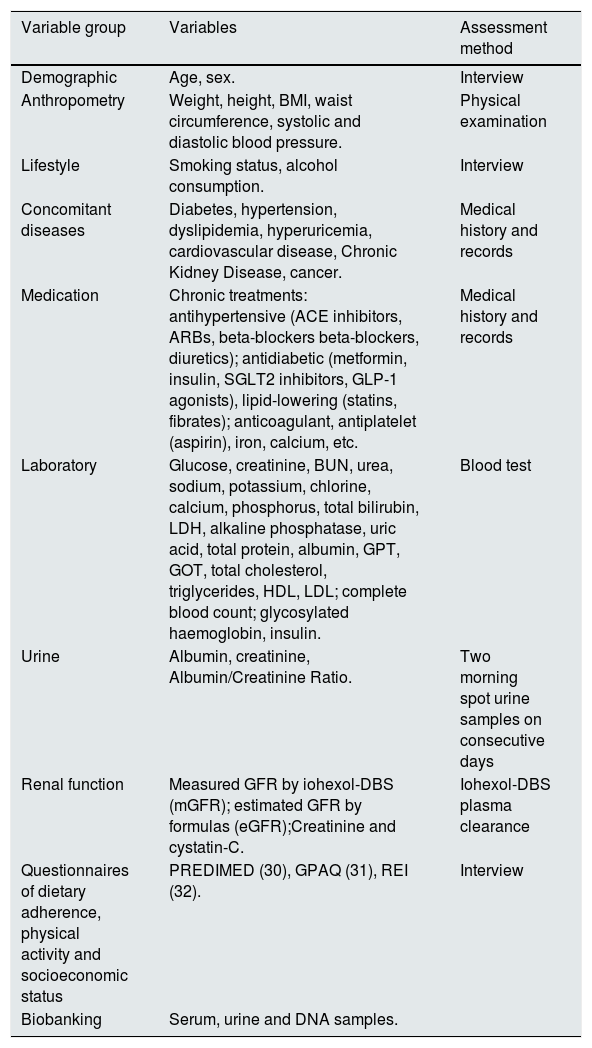
The main variables collected in the study are detailed in Table 1.
Main variables collected in the Mulagua study.
| Variable group | Variables | Assessment method |
|---|---|---|
| Demographic | Age, sex. | Interview |
| Anthropometry | Weight, height, BMI, waist circumference, systolic and diastolic blood pressure. | Physical examination |
| Lifestyle | Smoking status, alcohol consumption. | Interview |
| Concomitant diseases | Diabetes, hypertension, dyslipidemia, hyperuricemia, cardiovascular disease, Chronic Kidney Disease, cancer. | Medical history and records |
| Medication | Chronic treatments: antihypertensive (ACE inhibitors, ARBs, beta-blockers beta-blockers, diuretics); antidiabetic (metformin, insulin, SGLT2 inhibitors, GLP-1 agonists), lipid-lowering (statins, fibrates); anticoagulant, antiplatelet (aspirin), iron, calcium, etc. | Medical history and records |
| Laboratory | Glucose, creatinine, BUN, urea, sodium, potassium, chlorine, calcium, phosphorus, total bilirubin, LDH, alkaline phosphatase, uric acid, total protein, albumin, GPT, GOT, total cholesterol, triglycerides, HDL, LDL; complete blood count; glycosylated haemoglobin, insulin. | Blood test |
| Urine | Albumin, creatinine, Albumin/Creatinine Ratio. | Two morning spot urine samples on consecutive days |
| Renal function | Measured GFR by iohexol-DBS (mGFR); estimated GFR by formulas (eGFR);Creatinine and cystatin-C. | Iohexol-DBS plasma clearance |
| Questionnaires of dietary adherence, physical activity and socioeconomic status | PREDIMED (30), GPAQ (31), REI (32). | Interview |
| Biobanking | Serum, urine and DNA samples. |
Abbreviations: CKD, chronic kidney disease; mGFR, measured glomerular filtration rate; eGFR, estimated glomerular filtration rate; BMI, body mass index; DBS, dried blood spot.
The Spanish population (47,435,537 inhabitants) was used as a reference to calculate the sample size. Assuming a confidence level of 95%, an accuracy of 1.6% and an expected prevalence of CKD of 10%, 1352 individuals would be required. Considering an expected drop out rate of 15% the cohort should consist of 1576 participants; with a droop out of 10% the total sample would be 1501. Finally, the study population will be n=1576. Ad interim analyses will be performed every three months to assess the need to adjust the sample size.
Sensitivity analysis- 1.
To ensure our findings remain comparable with existing literature and current clinical guidelines, we will perform a sensitivity analysis using BSA-adjusted GFR (ml/min/1.73m2). This will allow us to evaluate the robustness of our results and quantify the specific impact that indexation has on our study population.
- 2.
We will assess the mGFR values in our study population using age- and sex-specific percentiles, following the approach described in recent publications.36–38
- 3.
We will analyze the number and characteristics of cases with measured GFR values around the cut-off for CKD (60ml/min), i.e. ±20%, that does not fulfil the criteria for CKD.
Obtaining accurate data on the prevalence of CKD remains a challenge. Population studies available in Spain and neighbouring countries provided very diverse figures on the prevalence of CKD.7–9 This could be largely due to the use of estimated glomerular filtration rate based on creatinine or cystatin-C formulas, which not only introduce error margins of up to ±30%11 but also lead to CKD staging misclassification rates of 35% for cystatin C-based and 50% for creatinine-based equations.12 This limits the reliability of existing data and makes it necessary to conduct studies that use direct measurement of renal function using reference methods in order to obtain solid data on the actual prevalence of CKD. This information can serve as a basis for health planning of preventive measures and monitoring the progression of the disease.
On the other hand, the detection of CKD is based on a threshold of 60mL/min/1.73m2, a criterion that overlooks age-inappropriate loss of kidney function.9 For example, a glomerular filtration rate of 65mL/min/1.73m2 in a young adult is not classified as CKD, but it already represents a lower level of GFR that is not detected by the standard threshold. This determine a late diagnosis of the disease, limiting the knowledge of the real magnitude of the subjects suffering from renal disease. In fact, one study revealed that only 23% of patients with CKD had a recognized diagnosis. In addition, the non-specialized medical community and health authorities often identify only advanced renal failure (stage 5), overlooking the earlier stages that develop over years.39,40
The Mulagua study aims to clarify this gap by establishing the first Spanish group of subject of the general population in which renal function is assessed using a reference method such as iohexol plasma clearance using the dried blood spot (iohexol-DBS) method, to obtain an accurate figure for the actual prevalence of CKD. The study design is based on the inclusion of virtually the entire adult population of three municipalities on the island of La Gomera: Hermigua, Agulo, and Vallehermoso. Thus, community participation, supported by local institutions, helps to minimize selection bias and facilitates the obtaining of a sample that approximately reproduces the Spanish demographic pyramid, which is an important strength. This approach differs from other population studies such as the Norwegian RENIS-T6 study, which, although it used measured GFR by plasma iohexol clearance, used an age range for the sample of 50–62 years and excluded participants with diabetes mellitus, CKD, or previous cardiovascular events.41,42 The Mulagua study includes adults with and without risk factors, thus allowing a broader and more realistic description of the current Spanish population with and without renal disease.
This study will also make possible to determine the real impact of errors in GFR estimation formulas on diagnostic classification.11,14
The inclusion of metabolic markers is another important element of the study. Metabolic syndrome and insulin resistance are emerging renal risk factors that may be associated with accelerated deterioration of glomerular filtration.25 Therefore, the collection of different metabolic variables will allow for a detailed study of the role played by metabolic status in the prevalence of CKD.25–29 Other risk factors including diabetes mellitus, hypertension and cardiovascular events, will also be evaluated.
In addition, the availability of a serum, urine, and DNA biobank sets a precedent for future phases or longitudinal studies aimed at evaluating the progression of renal function and the various risk factors associated with it.
The study has limitations that must be addressed. First, we calculated the number of cases to be included based on an estimated prevalence of CKD of 10%. In the case the prevalence of CKD is found to be lower than this estimate, we may need to recalculate the sample size. This analysis will be performed regularly to check our original assumption. Also, the study does not include children, which may limit the analysis of renal disease and CKD in this population.
In conclusion, the Mulagua study as a whole will provide essential information for understanding the true magnitude of CKD in Spain, identifying classic and emerging risk factors associated with it, and it's possible underdiagnosis. This cohort will represent a national benchmark for kidney health, which will be a turning point for health planning, the implementation of prevention strategies, and the development of future research involved in the progression of the disease.
ORCID IDTalía Cury-Verano – 0009-0008-2499-4528.
Authors’ contributionsTC-V, RM-F, EP, and SL-L contributed to the conceptualization and design of the study. TC-V was responsible for the writing—original draft preparation. RM-F, MPC-M, AH-M, RM-P, and MJR-P contributed to the methodology, investigation, and project coordination. LD-M, TG-D, and SL-L were responsible for the iohexol clearance analysis, laboratory methodology, and calculation of results. AG-R, PD-M, and RM-R contributed to the clinical investigation and data collection. FG-R was responsible for the design and management of the project's databases. AG-D and JRP-M contributed to the processing and management of samples in the central laboratory. AJ-S was responsible for the formal statistical analysis. RGZ-Z contributed to the historical investigation and provided the documentary analysis of the Gomeran population used in this study. SL-L, EP, and RM-F provided supervision, resources, and project administration. EP and SL-L were responsible for the critical revision and final approval of the manuscript. All authors have read and agreed to the published version of the manuscript.
StatementsThe study protocol has been critically evaluated in an external advisor report.
Ethics statementsThis study was approved by the Ethics Committee of the Hospital Universitario de Canarias (CHUC_2024_71). All procedures are conducted in accordance with the Declaration of Helsinki and Good Clinical Practice guidelines. Participant data are handled in compliance with the General Data Protection Regulation (EU) 2016/679 (GDPR) and the Spanish Organic Law 3/2018 on Personal Data Protection. Written informed consent is obtained from all participants prior to their inclusion in the study.
Funding sourcesThis study is supported by the Instituto de Salud Carlos III (ISCIII) through the research project PI23/01948, titled “Spanish cohort of renal health: MULAGUA project”, and is co-funded by the European Union.
Conflict of interestThe authors declare that they have no conflicts of interest.
The authors would like to thank the Red de Investigación Renal RICORS (ISCIII) for funding the MULAGUA study, the project “Diabetes, Obesity and the Kidney” (DOKI), and the Instituto de Salud Carlos III (ISCIII) for their financial support. We also thank the Fundación Canaria Instituto de Investigación Sanitaria de Canarias (FIISC) for their essential support in the administrative management and technical coordination, and the Instituto de Tecnologías Biomédicas (ITB) of the Universidad de La Laguna for their scientific and technical support. We are grateful to the Cabildo Insular de La Gomera and the local authorities and health management teams of the municipalities of Hermigua, Agulo and Vallehermoso for their institutional commitment and collaboration. We also extend our gratitude to the clinical staff and all the participants whose collaboration has been fundamental to the development of this project.
The followings are the supplementary data to this article: