
The optimal technique for Tenckhoff catheter insertion in peritoneal dialysis (PD) remains debated. We compared long-term outcomes of laparoscopic (LAP) and F at a tertiary nephrology centre.
ObjectivesTo analyse early and late complications, catheter survival, and independent predictors of outcome for both techniques.
MethodsRetrospective cohort study of 190 Tenckhoff catheters inserted between October 2009 and March 2025 (minimum 12-month follow-up, censored March 2026). LAP (n=119) and FL (n=71) techniques were compared using Kaplan–Meier, Cox regression and logistic regression.
ResultsGroups differed in age (median LAP 61 vs FL 69 years, p=0.001), prior abdominal surgery (51% vs 11%, p<0.001), and prior catheter (29% vs 0%, p<0.001), reflecting a structured selection policy. Peritoneal leak was more frequent with LAP (35.3% vs 18.3%, p=0.013) and haemoperitoneum with FL (15.5% vs 2.5%, p=0.001). Late exit-site infection was more frequent in the LAP group (33.3% vs 15.6%, p=0.010). Catheter survival did not differ significantly (median LAP 895 vs FL 645 days, log-rank p=0.231). Technique was not an independent predictor on Cox regression (HR 1.460, p=0.052); whereas serum albumin was (HR 0.609, p=0.002). Laparoscopic technique independently predicted late exit-site infection (OR 3.3, 95% CI 1.4–7.9, p=0.006).
ConclusionsThe two techniques carry distinct complication profiles despite comparable catheter survival. The higher rate of late exit-site infection with LAP may be attributable to exit-site fixation sutures at our centre. Serum albumin was the only predictor of catheter longevity, supporting timely catheter placement and clinical optimisation prior to PD initiation.
La técnica óptima de inserción del catéter de Tenckhoff para diálisis peritoneal (DP) sigue siendo objeto de debate. Comparamos los resultados a largo plazo de la inserción laparoscópica (LAP) y percutánea guiada por fluoroscopia (FL) en un centro terciario.
ObjetivosAnalizar las complicaciones precoces y tardías, la supervivencia del catéter y los predictores independientes de resultado en ambas técnicas.
Material y métodosEstudio de cohorte retrospectivo con 190 catéteres de Tenckhoff insertados entre octubre de 2009 y marzo de 2025 (seguimiento mínimo 12 meses, censurado en marzo de 2026). Se compararon LAP (n=119) y FL (n=71) mediante Kaplan-Meier, regresión de Cox y regresión logística.
ResultadosLos grupos difirieron en edad (mediana LAP 61 vs FL 69 años, p=0,001), cirugía abdominal previa (51% vs 11%, p<0,001) y catéter previo (29% vs 0%, p<0,001), reflejando una política de selección estructurada. La fuga peritoneal fue más frecuente con LAP (35,3% vs 18,3%, p=0,013) y el hemoperitônio con FL (15,5% vs 2,5%, p=0,001). La infección de orificio de salida (IOS) tardía fue más frecuente en el grupo LAP (33,3% vs 15,6%, p=0,010). La supervivencia del catéter no difirió significativamente (mediana LAP 895 vs FL 645 días, log-rank p=0,231). La técnica no fue un predictor independiente de supervivencia en la regresión de Cox (HR 1,460, p=0,052); la albúmina sérica fue el único predictor independiente (HR 0,609, p=0,002). La técnica laparoscópica fue un predictor independiente de IOS tardía (OR 3,3, IC 95% 1,4-7,9, p=0,006).
ConclusionesAmbas técnicas presentan perfiles de complicaciones distintos con supervivencia del catéter comparable. La mayor tasa de IOS tardía con LAP podría estar relacionada con la sutura de fijación del orificio de salida utilizada en nuestro centro. La albúmina sérica fue el único predictor de longevidad del catéter, apoyando la colocación precoz y la optimización clínica previa al inicio de DP.
Peritoneal dialysis (PD) is a home-based kidney replacement therapy with well-established advantages over haemodialysis, including preservation of residual renal function and greater patient autonomy.1 Successful PD requires reliable peritoneal access through a well-functioning Tenckhoff catheter. Catheter-related complications remain the leading cause of technique failure.2
Four main insertion techniques are currently used: open surgical, laparoscopic, percutaneous (Seldinger technique), and peritoneoscopic.3 Laparoscopic insertion allows direct visualisation and adhesiolysis, if needed, but requires general anaesthesia and theatre resources. Fluoroscopy-guided percutaneous insertion can be performed by nephrologists under local anaesthesia, making it a practical option for older or medically frail patients.4
The 2019 ISPD guidelines and the 2023 SAGES update acknowledge that evidence for technique selection remains limited.5,6 A Cochrane review identified only 17 eligible RCTs, none comparing advanced laparoscopic with fluoroscopy-guided percutaneous insertion.7 A 2025 meta-analysis found lower rates of early peritonitis and catheter failure with percutaneous techniques, but evidence certainty was low.8
We report the outcomes of 190 Tenckhoff catheters inserted over 15 years at a single tertiary centre in Portugal, comparing laparoscopic and fluoroscopy-guided percutaneous techniques for early and late complications, catheter survival, and predictors of outcome.
MethodsStudy design and populationThis was a single-centre retrospective cohort study. All Tenckhoff catheters inserted for PD between October 2009 and March 2025 at Hospital Garcia de Orta (HGO), a tertiary nephrology centre in Almada, Portugal, were eligible for inclusion. Catheters with less than 12 months of follow-up were excluded. The final censoring date was 31 March 2026. The study was approved by the Ethics Committee of HGO. Informed consent was waived given the retrospective nature of the study and use of anonymised data.
Insertion techniquesLaparoscopic insertion (LAP) was performed under general anaesthesia by a dedicated surgical team. Standard technique involved pneumoperitoneum, direct visualisation and placement of the catheter tip in the pelvis, with adhesiolysis performed as required. A fixation suture was systematically placed at the exit site to prevent catheter displacement.
Fluoroscopy-guided percutaneous insertion (FL) was performed by nephrologists using the Seldinger technique under local anaesthesia, with fluoroscopic guidance to confirm catheter position. No exit-site fixation suture was used with this technique.
Technique selection was not random. Patients with prior abdominal surgery, abdominal wall hernia, prior PD catheter, or ADPKD were allocated to LAP, given the higher risk of adhesions in these cases or the need for surgical correction of the hernia. In ADPKD, the blind technique carries additional iatrogenic risk, as massive renal enlargement and cyst distortion render standard anatomical landmarks unreliable. Percutaneous insertion was preferred for older or medically frail patients without these risk factors. This structured policy is reflected in the baseline differences between groups and was accounted for in the multivariate analyses.
Data collectionBaseline demographic and clinical data were extracted from electronic medical records, including age, sex, body mass index (BMI), serum albumin, estimated glomerular filtration rate (eGFR), serum creatinine, diabetes mellitus, smoking history, prior abdominal surgery, prior PD catheter, aetiology of chronic kidney disease (CKD), and PD modality. Complications were classified as early (≤30 days) or late (>30 days). Catheter removal causes, PD modality, and follow-up data were also recorded.
Statistical analysisContinuous variables were described as mean±standard deviation or median [interquartile range] per distribution assessed by the Shapiro–Wilk test. Categorical variables were presented as frequencies and percentages. Between-group comparisons used the Mann–Whitney U or independent t-test for continuous variables, and chi-square or Fisher's exact test for categorical variables. Catheter survival was estimated by Kaplan–Meier curves and compared with the log-rank test. Multivariate Cox regression identified independent predictors of catheter survival, including variables with p<0.1 on univariable analysis. Logistic regression assessed predictors of late exit-site infection. Statistical significance was set at p<0.05. Analyses were performed using SPSS version 25.0.
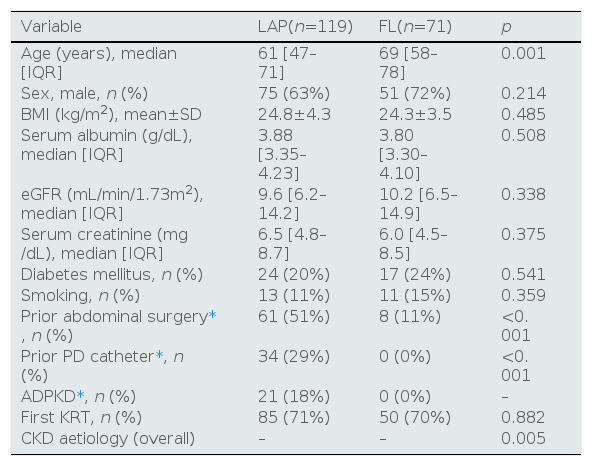
ResultsPatient characteristicsA total of 190 Tenckhoff catheters were included: 119 (62.6%) laparoscopic and 71 (37.4%) percutaneous. Baseline characteristics are summarised in Table 1. The FL group was older (median 69 [58–78] vs 61 [47–71] years, p=0.001), had less prior abdominal surgery (11% vs 51%, p<0.001), and no prior PD catheters (0% vs 29%, p<0.001). Both groups were comparable for sex (p=0.214), BMI (p=0.485), serum albumin (p=0.508), eGFR (p=0.338), and diabetes mellitus (p=0.541). CKD aetiology distribution differed between groups (p=0.005), except ADPKD that was exclusive to the LAP group (n=21, 18%).
Baseline characteristics.
| Variable | LAP(n=119) | FL(n=71) | p |
|---|---|---|---|
| Age (years), median [IQR] | 61 [47–71] | 69 [58–78] | 0.001 |
| Sex, male, n (%) | 75 (63%) | 51 (72%) | 0.214 |
| BMI (kg/m2), mean±SD | 24.8±4.3 | 24.3±3.5 | 0.485 |
| Serum albumin (g/dL), median [IQR] | 3.88 [3.35–4.23] | 3.80 [3.30–4.10] | 0.508 |
| eGFR (mL/min/1.73m2), median [IQR] | 9.6 [6.2–14.2] | 10.2 [6.5–14.9] | 0.338 |
| Serum creatinine (mg/dL), median [IQR] | 6.5 [4.8–8.7] | 6.0 [4.5–8.5] | 0.375 |
| Diabetes mellitus, n (%) | 24 (20%) | 17 (24%) | 0.541 |
| Smoking, n (%) | 13 (11%) | 11 (15%) | 0.359 |
| Prior abdominal surgery*, n (%) | 61 (51%) | 8 (11%) | <0.001 |
| Prior PD catheter*, n (%) | 34 (29%) | 0 (0%) | <0.001 |
| ADPKD*, n (%) | 21 (18%) | 0 (0%) | – |
| First KRT, n (%) | 85 (71%) | 50 (70%) | 0.882 |
| CKD aetiology (overall) | – | – | 0.005 |
Values are median [IQR] or n (%). Groups reflect the structured technique selection policy (see Methods). BMI: body mass index; eGFR: estimated glomerular filtration rate; ADPKD: autosomal dominant polycystic kidney disease; KRT: kidney replacement therapy; CKD: chronic kidney disease; PD: peritoneal dialysis.
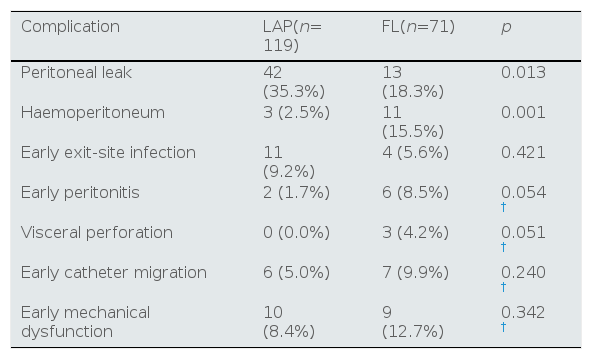
Early complications are shown in Table 2. Peritoneal leak was more frequent with LAP (35.3% vs 18.3%, p=0.013), likely related to the larger trocar incisions. Haemoperitoneum was more common with FL (15.5% vs 2.5%, p=0.001), consistent with the risk inherent to needle passage despite fluoroscopic guidance. No significant differences were found in early exit-site infection (9.2% vs 5.6%, p=0.421), early peritonitis (1.7% vs 8.5%, Fisher p=0.054), visceral perforation (0.0% vs 4.2%, Fisher p=0.051), early catheter migration (5.0% vs 9.9%, p=0.240), or early mechanical dysfunction (8.4% vs 12.7%, p=0.342).
Early complications (≤30 days).
| Complication | LAP(n=119) | FL(n=71) | p |
|---|---|---|---|
| Peritoneal leak | 42 (35.3%) | 13 (18.3%) | 0.013 |
| Haemoperitoneum | 3 (2.5%) | 11 (15.5%) | 0.001 |
| Early exit-site infection | 11 (9.2%) | 4 (5.6%) | 0.421 |
| Early peritonitis | 2 (1.7%) | 6 (8.5%) | 0.054† |
| Visceral perforation | 0 (0.0%) | 3 (4.2%) | 0.051† |
| Early catheter migration | 6 (5.0%) | 7 (9.9%) | 0.240† |
| Early mechanical dysfunction | 10 (8.4%) | 9 (12.7%) | 0.342† |
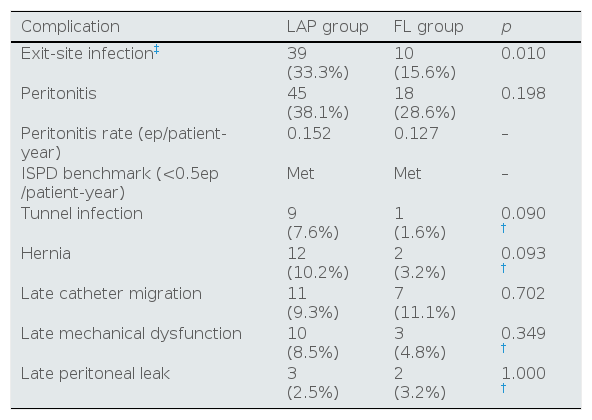
Late exit-site infection was more frequent in the LAP group (33.3% vs 15.6%, p=0.010). No differences were found in peritonitis (38.1% vs 28.6%, p=0.198), tunnel infection (7.6% vs 1.6%, p=0.090), hernia (10.2% vs 3.2%, p=0.093), catheter migration (9.3% vs 11.1%, p=0.702), or mechanical dysfunction (8.5% vs 4.8%, p=0.349). Peritonitis rates were 0.152 and 0.127 episodes per patient-year in the LAP and FL groups respectively, both below the ISPD benchmark of 0.5 episodes/patient-year (Table 3).
Late complications (>30 days).
| Complication | LAP group | FL group | p |
|---|---|---|---|
| Exit-site infection‡ | 39 (33.3%) | 10 (15.6%) | 0.010 |
| Peritonitis | 45 (38.1%) | 18 (28.6%) | 0.198 |
| Peritonitis rate (ep/patient-year) | 0.152 | 0.127 | – |
| ISPD benchmark (<0.5ep/patient-year) | Met | Met | – |
| Tunnel infection | 9 (7.6%) | 1 (1.6%) | 0.090† |
| Hernia | 12 (10.2%) | 2 (3.2%) | 0.093† |
| Late catheter migration | 11 (9.3%) | 7 (11.1%) | 0.702 |
| Late mechanical dysfunction | 10 (8.5%) | 3 (4.8%) | 0.349† |
| Late peritoneal leak | 3 (2.5%) | 2 (3.2%) | 1.000† |
Denominator: catheters with >30 days follow-up (n=181). Denominators vary slightly by variable due to missing data (LAP n=117–118, FL n=63–64). ISPD: International Society for Peritoneal Dialysis.
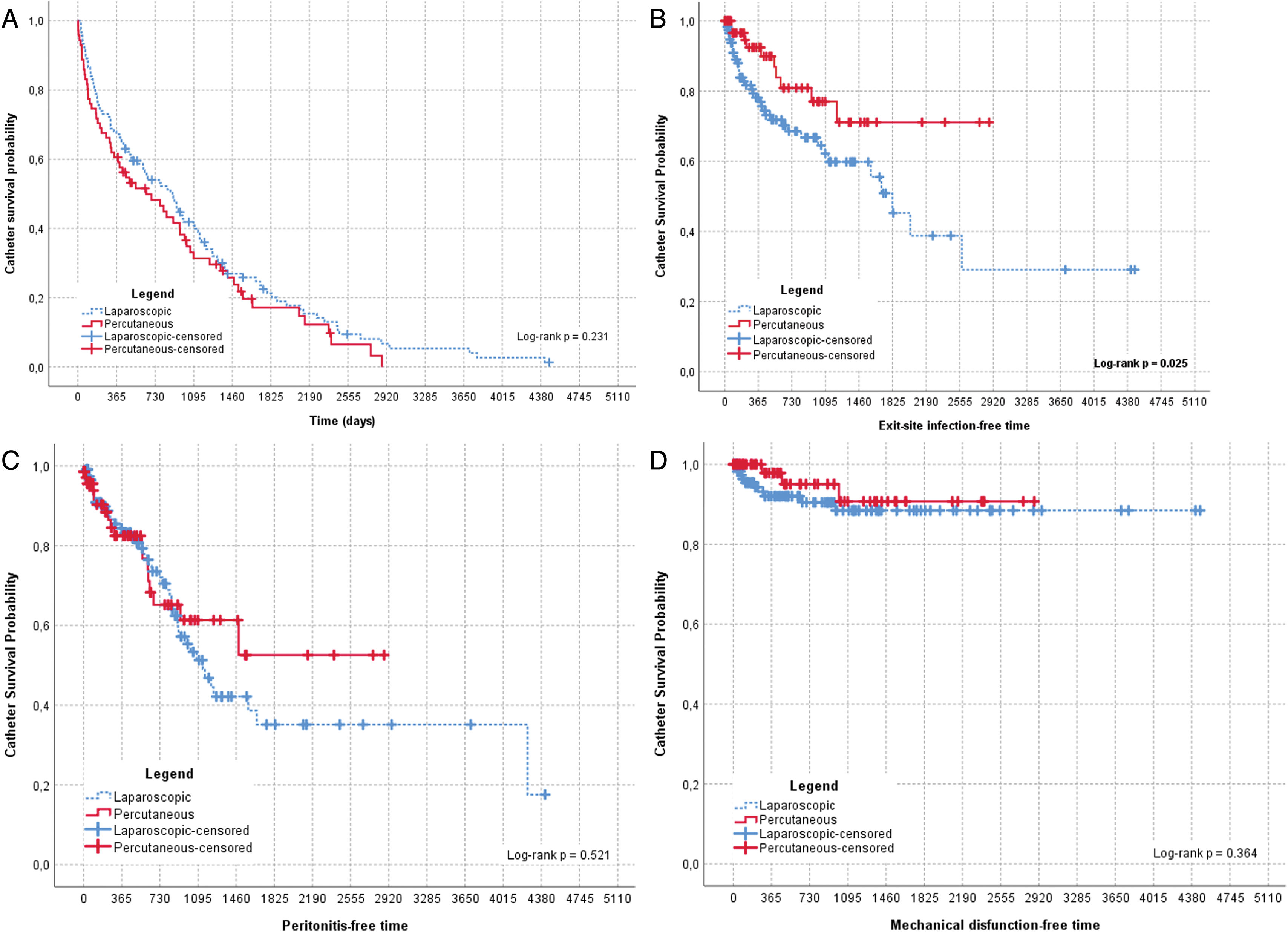
Kaplan–Meier curves are shown in Fig. 1. Median catheter survival was 895 days (95% CI 635–1155) for LAP and 645 days (95% CI 241–1049) for FL (log-rank p=0.231). Exit-site infection-free survival favoured FL (log-rank p=0.025). Peritonitis-free (p=0.521) and mechanical dysfunction-free (p=0.364) survival did not differ.

Kaplan–Meier curves for catheter survival (a), exit-site infection-free survival (b), peritonitis-free survival (c), and mechanical dysfunction-free survival (d), stratified by insertion technique. LAP: laparoscopic; FL: fluoroscopy-guided percutaneous. Tick marks indicate censored observations. p values from log-rank test.
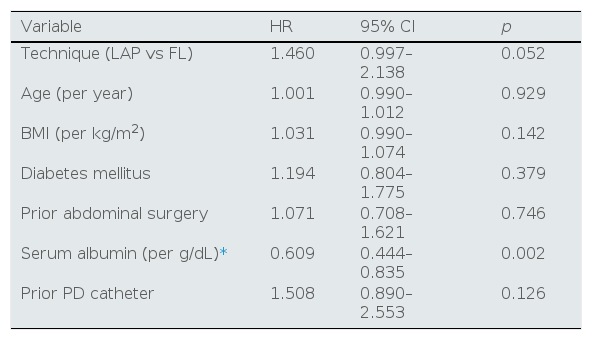
On Cox regression (Table 4), technique was not an independent predictor of catheter survival (HR 1.460, 95% CI 0.997–2.138, p=0.052). Serum albumin was the only independent predictor: each 1g/dL increase corresponded to a 39% reduction in the risk of catheter failure (HR 0.609, 95% CI 0.444–0.835, p=0.002). On logistic regression, laparoscopic technique was an independent predictor of late exit-site infection (OR 3.3, 95% CI 1.4–7.9, p=0.006). The Hosmer–Lemeshow test confirmed adequate model fit (p=0.284).
Multivariate Cox regression – predictors of catheter survival (n=179).
| Variable | HR | 95% CI | p |
|---|---|---|---|
| Technique (LAP vs FL) | 1.460 | 0.997–2.138 | 0.052 |
| Age (per year) | 1.001 | 0.990–1.012 | 0.929 |
| BMI (per kg/m2) | 1.031 | 0.990–1.074 | 0.142 |
| Diabetes mellitus | 1.194 | 0.804–1.775 | 0.379 |
| Prior abdominal surgery | 1.071 | 0.708–1.621 | 0.746 |
| Serum albumin (per g/dL)* | 0.609 | 0.444–0.835 | 0.002 |
| Prior PD catheter | 1.508 | 0.890–2.553 | 0.126 |
One hundred sixty-two events. HR: hazard ratio; CI: confidence interval; LAP: laparoscopic; FL: fluoroscopy-guided percutaneous.
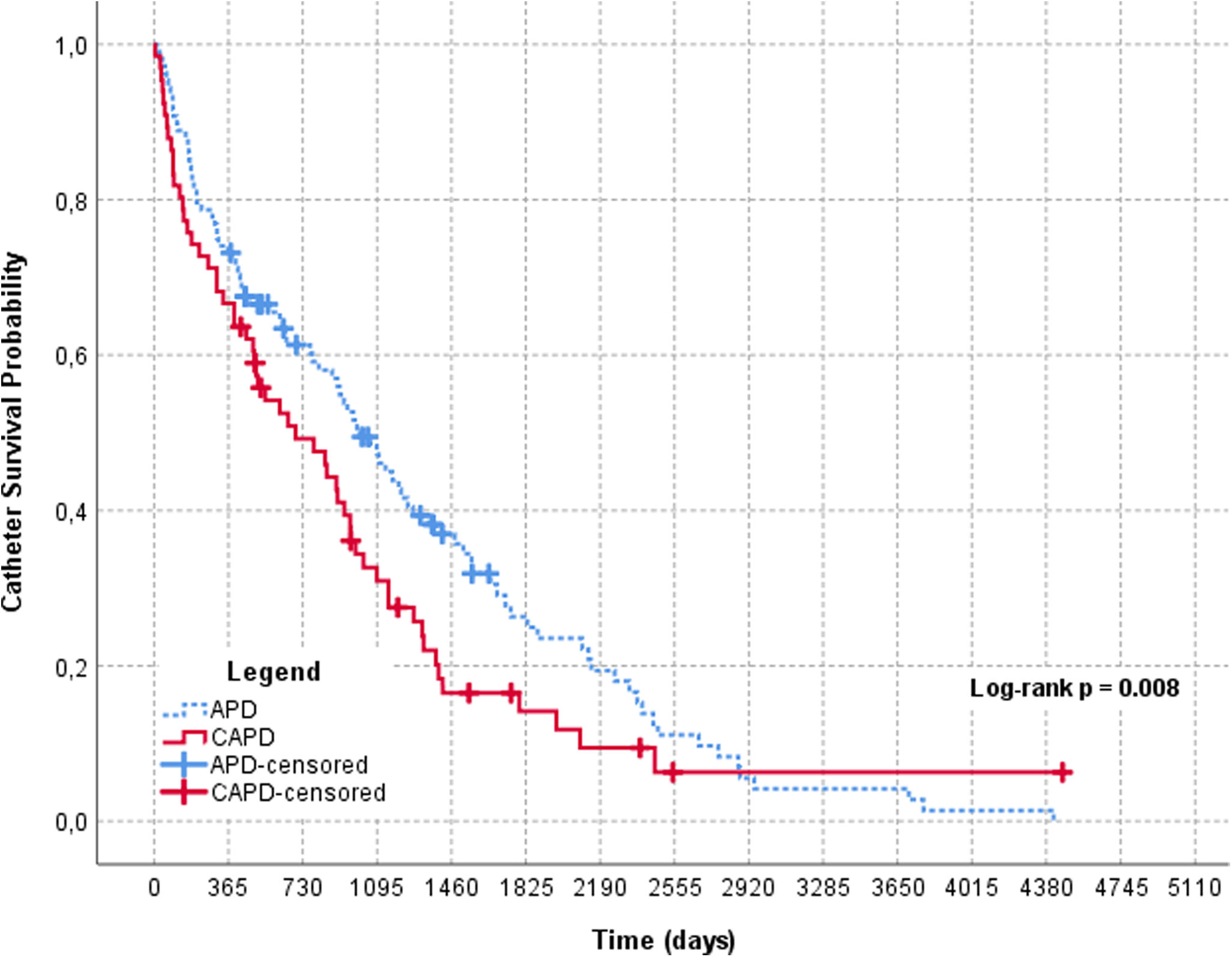
In an exploratory analysis (n=174, excluding 16 catheters without documented modality), APD was associated with significantly longer catheter survival compared to CAPD (median 997 days [95% CI 771–1223] vs 510 days [95% CI 318–702], log-rank p=0.008). Catheter survival functions are shown in Fig. 2.
Discussion
In this 15-year cohort of 190 catheter insertions, laparoscopic and fluoroscopy-guided percutaneous techniques showed distinct complication profiles but comparable catheter survival. Peritoneal leak was more frequent with LAP, haemoperitoneum with FL, and laparoscopic technique independently predicted late exit-site infection. Serum albumin at insertion was the only predictor of catheter longevity.
The baseline differences between groups reflect a deliberate technique selection policy, consistent with international guidelines: patients with prior abdominal surgery, prior catheter, or ADPKD are allocated to LAP, whilst FL is preferred for older or frailer patients without these risk factors.5 This non-random allocation is inherent to retrospective comparative studies of insertion technique and was addressed by multivariate adjustment, though residual confounding cannot be excluded.
The higher rate of peritoneal leak with laparoscopic insertion is well recognised and related to the larger trocar incisions.10 Haemoperitoneum with FL, although clinically concerning, is generally self-limited and was not associated with excess catheter failure in our cohort. Fluoroscopic guidance reduces mal-positioning but does not eliminate the vascular risk inherent to the Seldinger needle insertion step. In some cases the use of ultrasound during puncture can reduce that risk. The higher rate of late exit-site infection in the LAP group requires careful consideration. Laparoscopic technique remained an independent predictor after multivariate adjustment. We hypothesise that the exit-site fixation suture used systematically in LAP – but not FL – at our centre may act as an additional focus for bacterial colonisation. This centre-specific practice should be evaluated prospectively.
Serum albumin as the sole independent predictor of catheter survival also merits discussion. Hypoalbuminaemia in advanced CKD reflects multiple processes: chronic inflammation, uraemic anorexia, proteinuria, and the catabolic state of kidney failure.11 In our cohort, albumin did not correlate with eGFR (Spearman r=0.001, p=0.988), indicating it captures aspects of the patient's overall condition beyond residual renal function alone. These data support timely catheter placement and addressing modifiable contributors to hypoalbuminaemia prior to PD initiation.11
APD was associated with longer catheter survival compared to CAPD (median 997 vs 510 days, p=0.008). This is consistent with observational data showing lower all-cause mortality with APD.12 A meta-analysis of 17 studies in over 230,000 patients found a significant survival advantage for APD (HR 0.87, 95% CI 0.77–0.99), though PD technique survival was similar between modalities.13 Whether APD also preserves catheter longevity – possibly through fewer manual exchanges and lower infection exposure – requires prospective evaluation.
This study has several limitations. The retrospective design and non-random technique allocation preclude definitive causal inference. The groups were not comparable at baseline, and multivariate adjustment cannot fully eliminate residual confounding. The exclusive allocation of all ADPKD patients to LAP constitutes a structural confound; the exit-site infection association should be interpreted with this in mind. Exit-site fixation suture use in the LAP group is a centre-specific practice that may limit generalisability. The modality analysis is exploratory given missing data in 16 catheters.
ConclusionsLaparoscopic and fluoroscopy-guided percutaneous insertion show distinct complication profiles but comparable catheter survival. Laparoscopic technique was independently associated with higher rates of late exit-site infection, possibly related to exit-site fixation suture use at our centre. Serum albumin was the only predictor of catheter longevity; its independence from eGFR suggests it reflects overall patient condition rather than renal function alone, supporting timely catheter placement and pre-PD clinical optimisation. Technique selection should remain individualised based on patient characteristics and centre expertise. Prospective multicentre studies with standardised protocols are needed.
- •
Laparoscopic and percutaneous insertion show distinct complication profiles with comparable catheter survival at 15 years of follow-up.
- •
Late exit-site infection is significantly more frequent with laparoscopic technique; exit-site fixation suture use is hypothesised as a contributing factor.
- •
Serum albumin is the only independent predictor of catheter survival and does not correlate with eGFR, suggesting it reflects overall patient condition.
- •
APD was associated with longer catheter survival compared to CAPD in an exploratory analysis.
- •
Technique selection should be individualised according to patient characteristics and centre expertise.
All procedures were conducted in accordance with the Declaration of Helsinki. Informed consent was waived given the retrospective nature of the study and use of anonymised data.
Declaration of generative AI and AI-assisted technologies in the writing processDuring the preparation of this work the author(s) used Claude by Anthropic in order to for grammar and language editing assistance. After using this tool/service, the authors reviewed and edited the content as needed and take full responsibility for the content of the published article.
FundingNo specific funding was received for this study.
Conflict of interestThe authors declare no conflict of interest.
Uncited references9,14.