



Expanded hemodialysis (HDx) utilizing medium-cut-off membranes has emerged as a viable alternative to online hemodiafiltration (OL-HDF). HDx offers comparable removal of middle molecules and does not necessitate replacement fluids or supplementary infrastructure. This study focuses on the operating costs of the two modalities and assesses some of the economic and environmental implications of HDx in comparison to OL-HDF, in particular water consumption.
MethodsA micro-costing analysis was conducted from the perspective of a healthcare provider in Spain. Resource utilization per HDx and OL-HDF session was quantified, and unit costs were derived from administrative records and expressed in euros for the year 2024. Deterministic and probabilistic sensitivity analyses were conducted to examine variability in costs and water consumption.
ResultsIn the base case, HDx was associated with net savings of €2.7 per session compared to OL-HDF. This was mainly due to the elimination of the OL-HDF substitution line requirement and lower water use. Across various sensitivity scenarios, savings ranged from €2.70 to €6.60 per session. The probabilistic analysis indicated that HDx was the dominant strategy in 90% of 1000 simulations, resulting in annual savings of about €428 per patient-year. Regarding environmental impact, HDx had a water consumption of 120 liters per session, versus 150 liters for OL-HDF. Over five years, a group of 1000 patients treated with HDx would save approximately 23.4 million liters of water.
ConclusionsHDx with Theranova offers lower resource use and lower costs compared to OL-HDF by reducing the need for specific consumables other than the dialyzer and for water consumption. These findings support the potential benefit of HDx as an efficient dialysis modality that responsibly uses the planet's resources.
La hemodiálisis expandida (HDx) con membranas de corte medio se ha consolidado como una alternativa viable a la hemodiafiltración en línea (OL-HDF). La HDx ofrece una eliminación comparable de moléculas de tamaño medio y no requiere fluidos de reemplazo ni infraestructura adicional. Este estudio se centra en los costos operativos de ambas modalidades y evalúa algunas de las implicaciones económicas y ambientales de la HDx en comparación con la OL-HDF, en particular el consumo de agua.
MétodosSe realizó un análisis de micro costeo desde la perspectiva de un proveedor de atención médica en España. Se cuantificó la utilización de recursos por sesión de HDx y OL-HDF, y los costos unitarios se obtuvieron de registros administrativos y se expresaron en euros para el año 2024. Se realizaron análisis de sensibilidad determinísticos y probabilísticos para examinar la variabilidad de los costos y el consumo de agua.
ResultadosEn el caso base, la HDx se asoció con un ahorro neto de 2,7 €por sesión en comparación con la OL-HDF. Esto se debió principalmente a la eliminación de la necesidad de la línea de sustitución de la OL-HDF y a un menor consumo de agua. En diversos escenarios de sensibilidad, el ahorro osciló entre 2,70 €y 6,60 €por sesión. El análisis probabilístico indicó que la HDx fue la estrategia dominante en el 90% de las 1.000 simulaciones, lo que se tradujo en un ahorro anual de aproximadamente 428 €por paciente-año. En cuanto al impacto ambiental, la HDx tuvo un consumo de agua de 120 litros por sesión, frente a los 150 litros de la OL-HDF. En cinco años, un grupo de 1.000 pacientes tratados con HDx ahorraría aproximadamente 23,4 millones de litros de agua.
ConclusiónLa HDx con Theranova ofrece un menor consumo de recursos y menores costes en comparación con la OL-HDF, al reducir la necesidad de consumibles específicos distintos del dializador y el consumo de agua. Estos hallazgos respaldan el beneficio potencial de la HDx como una modalidad de diálisis eficiente que utiliza de forma responsable los recursos del planeta.
Kidney failure represents a significant clinical and economic challenge to healthcare systems worldwide, particularly in countries with limited resources.1 Although kidney replacement therapy using conventional hemodialysis with high-flux membranes (HF-HD) is effective in removing small and some medium-sized molecules, its performance is less satisfactory in terms of removal of larger molecules including several important uremic toxins associated with inflammation, cardiovascular dysfunction, and resistance to erythropoiesis-stimulating agents.2
Online hemodiafiltration (OL-HDF) is compared to HF-HD a more effective alternative to improve the clearance of higher-molecular-weight solutes and has demonstrated clinical benefits in several studies. However, implementing OL-HDF requires advanced infrastructure, ultrapure water, replacement fluids, and higher operating costs, which limit its applicability mostly to well-equipped dialysis centers whereas the use of OL-HDF in less advanced clinical settings with limited resources may pose some problems.3
In this context, expanded hemodialysis (HDx) has recently emerged as an innovative therapy, that is easy to implement, and capable of efficiently clearing large and medium-sized molecules without the requirements of the organizational and physical infrastructure that is needed for OL-HDF. Instead, the use of HDx using the same technological infrastructure employed in HF-HD, with the sole modification being the type of dialyzer, which transitions from a high-flux dialyzer to a dialyzer with a medium cut-off membrane (Theranova). Accordingly, it does not necessitate fluid replacement or structural modifications to the clinical procedure.4
Clinical studies have demonstrated that HDx compared with HF-HD results in a greater reduction of several large molecules such as kappa and lambda free light chains and inflammatory mediators, while maintaining stable serum albumin levels.5 Comparative studies suggest that HDx achieves similar removal of middle molecules as OL-HDF, including β2-microglobulin, fibroblast growth factor 23 (FGF-23), and chitinase-3-like protein 1 (YKL-40).6 In a Latin American cohort, a 21% reduction in mortality was reported with the use of HDx compared to HF-HD, with maintenance of albumin levels.7
Some authors have demonstrated that HDx and OL-HDF are superior to conventional hemodialysis (HF-HD) in effectively clearing middle molecules that may have unfavorable impact on clinical outcomes, such as cardiovascular events, hospitalization, quality of life, and mortality.8–12 Therefore, it is essential to compare these kidney replacement therapies. In this aspect, the multicenter MOTheR HDx study,13 a prospective, randomized clinical trial conducted in several Spanish hospitals, aimed to evaluate whether HDx therapy is non-inferior to OL-HDF in reducing all-cause mortality. Preliminary results indicate that HDx achieves a performance in terms of mortality reduction comparable to that reported for OL-HDF in the CONVINCE study, which compared OL-HDF with HF-HD.14
While the clinical profile of HDx is well-supported, its economic impact is less well studied. This study compared the direct costs for some components of the resource consumption associated with the use of HDx as compared to OL-HDF, using a microcosting approach from the provider's perspective, in the Spanish healthcare system. Additionally, this comparison takes into account the impact on water consumption.
MethodsStudy design and populationThis study compared the resource consumption and the associated direct medical costs of HDx and OL-HDF, using a micro-costing approach with a bottom-up methodology to construct the average case from the healthcare provider's perspective in the Spanish healthcare system. The costs associated with each replacement therapy were estimated by identifying the relevant resources, quantifying resource use per dialysis session, and assigning unit costs based on market prices.
The analysis was based on standardized dialysis treatment sessions representative of the adult kidney failure patients who received treatment with HDx or OL-HDF at a dialysis center in Spain. HDx, enabled by Theranova membrane, met the following criteria: a session duration of 4h and a frequency of 3 times per week with an arteriovenous fistula or graft, and a dialysis fluid flow rate of 500mL/min.
For OL-HDF, the mean convection volume was 25.2 liters per session (SD=2.7). Convective volume values were obtained from dialysis machine treatment reports, which automatically calculate substitution volume based on real-time treatment parameters including blood flow rate, treatment duration, and substitution flow during post-dilution OL-HDF. Assuming a total dialysate flow (total QD) of 625mL/min, consisting of a dialysate flow rate (QD) of 520mL/min and 105mL/min (equaling 25.2L/240min for substitution).14 The session duration was 4h, with a frequency of three times per week, with an arteriovenous fistula or graft. Both OL-HDF and HDx were performed with ultrapure dialysis fluids, defined as <0.1CFU/mL and <0.03EU/mL according to Sociedad Española de Nefrología (S.E.N.) guidelines.15 The dialysate composition was the same in both groups.
This study was designed as a micro-costing resource consumption analysis rather than a clinical effectiveness comparison; a formal sample size calculation was not required. The analysis was based on the identification and quantification of resource use per dialysis session using standardized treatment protocols.
Data collectionDirect medical costs were included, while personnel, medications, dialysis equipment, and monitors were excluded because they were assumed to be similar across both modalities and therefore irrelevant to the differential analysis. The resource identification and related consumption data were collected in detail on-site, and a thorough review of administrative records was conducted to identify resources. Cost components were validated and adjusted based on informal consensus among expert nephrologists and nurses. A final list was compiled, and quantities were validated according to established protocols for HDx and OL-HDF treatments. Water quantities were derived from building consumption records, and as a result, the waste generated during the purification process was included.
Unit costs were obtained directly from administrative records (paid invoices) to reflect the actual amounts paid for each resource, including taxes, at a renal clinic in Murcia, Spain. All costs were expressed in euros (€2024), and since the unit of analysis was the dialysis session, it was unnecessary to apply a discount rate.
Statistical analysisThe analysis compared HDx and OL-HDF based on data for individual treatment sessions. A deterministic and probabilistic sensitivity analysis was performed to account for uncertainty in the estimates. In the deterministic analysis, the price of the Theranova membrane was varied to model hypothetical scenarios, and the inclusion of an additional saline solution bag was used to prime the lines for each OL-HDF session. Additionally, a Monte Carlo simulation with a five-year time horizon was used to estimate differences in water consumption. Statistical analyses were performed using Stata 16® (StataCorp, 2019. Stata Statistical Software: Release 16. College Station, TX: StataCorp LLC).
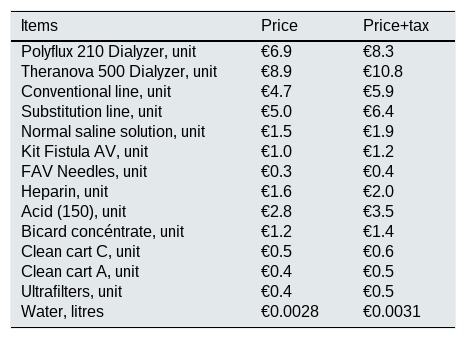
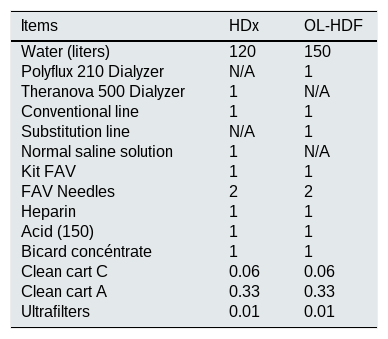
ResultsThe information used to build our base case is presented in Tables 1 and 2.
Itemization of resources needed, and corresponding assumed average session cost expressed as euros per unit (euros 2024).
| Items | Price | Price+tax |
|---|---|---|
| Polyflux 210 Dialyzer, unit | €6.9 | €8.3 |
| Theranova 500 Dialyzer, unit | €8.9 | €10.8 |
| Conventional line, unit | €4.7 | €5.9 |
| Substitution line, unit | €5.0 | €6.4 |
| Normal saline solution, unit | €1.5 | €1.9 |
| Kit Fistula AV, unit | €1.0 | €1.2 |
| FAV Needles, unit | €0.3 | €0.4 |
| Heparin, unit | €1.6 | €2.0 |
| Acid (150), unit | €2.8 | €3.5 |
| Bicard concéntrate, unit | €1.2 | €1.4 |
| Clean cart C, unit | €0.5 | €0.6 |
| Clean cart A, unit | €0.4 | €0.5 |
| Ultrafilters, unit | €0.4 | €0.5 |
| Water, litres | €0.0028 | €0.0031 |
Average use of consumables including water per dialysis session.
| Items | HDx | OL-HDF |
|---|---|---|
| Water (liters) | 120 | 150 |
| Polyflux 210 Dialyzer | N/A | 1 |
| Theranova 500 Dialyzer | 1 | N/A |
| Conventional line | 1 | 1 |
| Substitution line | N/A | 1 |
| Normal saline solution | 1 | N/A |
| Kit FAV | 1 | 1 |
| FAV Needles | 2 | 2 |
| Heparin | 1 | 1 |
| Acid (150) | 1 | 1 |
| Bicard concéntrate | 1 | 1 |
| Clean cart C | 0.06 | 0.06 |
| Clean cart A | 0.33 | 0.33 |
| Ultrafilters | 0.01 | 0.01 |
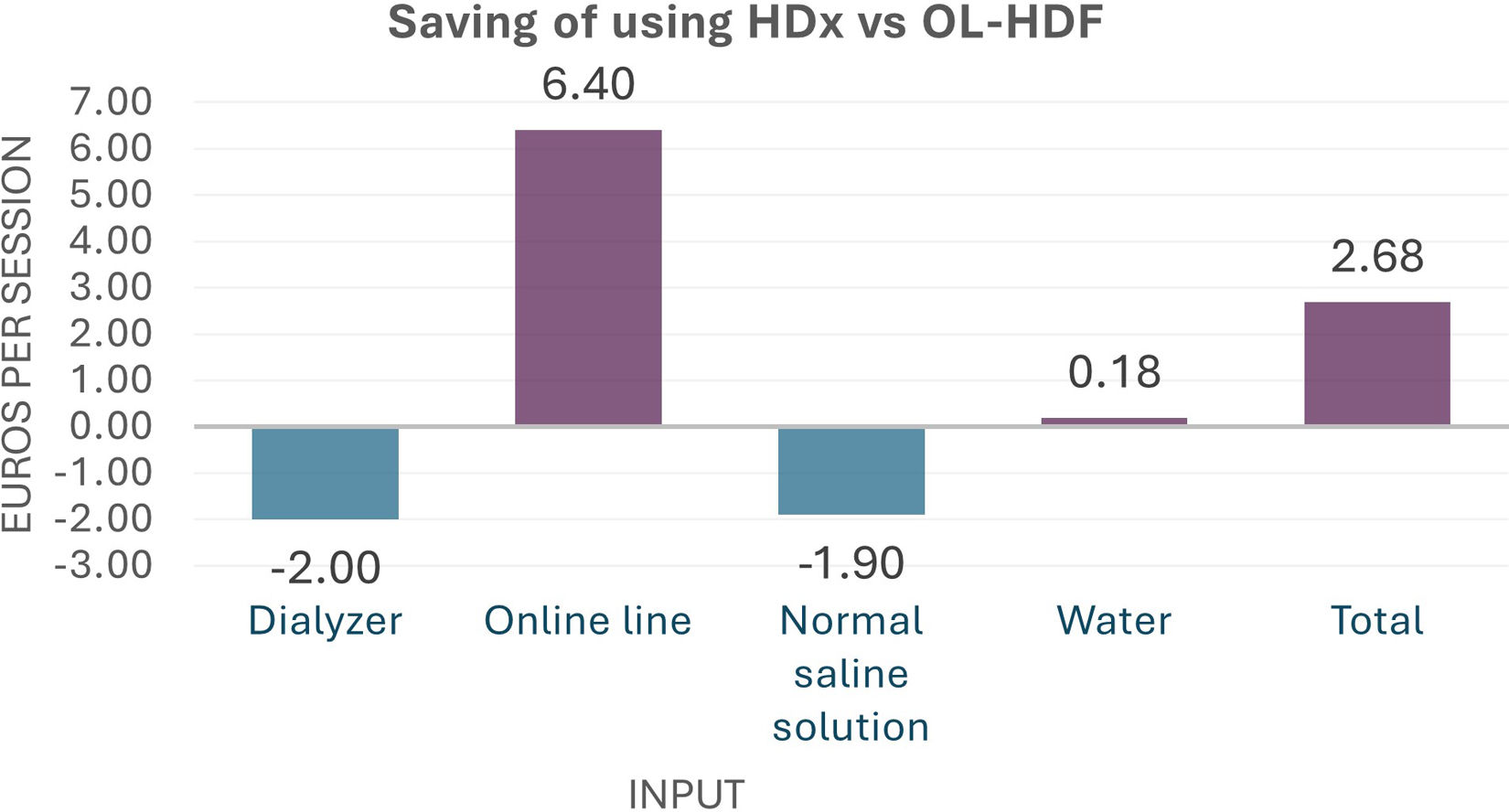
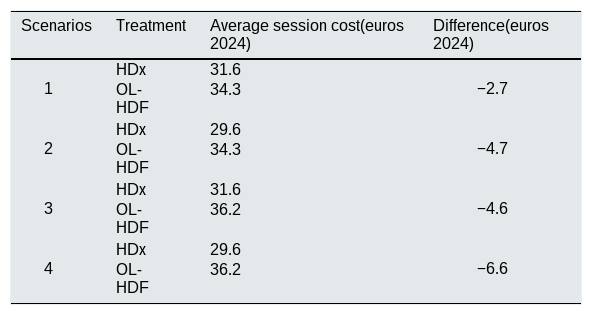
In the base case, assuming a €2.0 higher cost of Theranova compared to a high-flux dialyzer, HDx demonstrated net savings of €2.70 per session relative to OL-HDF, primarily due to the elimination of the OL-HDF substitution line and reduced water consumption (Fig. 1).
These results are maintained when the price of the Theranova dialyzer fluctuates, with resource savings of 2.7–4.7 euros per session. In a scenario that includes a saline solution as an input used in the priming process of the lines in online hemodiafiltration, HDx produces savings between 4.6 and 6.6 euros per session (Table 3).
Assumed average session costs and savings achieved by HDx as compared to OL-HDF in different scenarios.
| Scenarios | Treatment | Average session cost(euros 2024) | Difference(euros 2024) |
|---|---|---|---|
| 1 | HDx | 31.6 | −2.7 |
| OL-HDF | 34.3 | ||
| 2 | HDx | 29.6 | −4.7 |
| OL-HDF | 34.3 | ||
| 3 | HDx | 31.6 | −4.6 |
| OL-HDF | 36.2 | ||
| 4 | HDx | 29.6 | −6.6 |
| OL-HDF | 36.2 | ||
Assume that the price of the Theranova dialyzer is elevated by 2 euros compared to that of the high-flux dialyzer.
Assume that the price of the Theranova dialyzer is the same as that of the high-flux dialyzer.
Assume that the price of the Theranova dialyzer is elevated by 2 euros compared to that of the high-flux dialyzer and OL-HDF also requires the use of a normal saline solution bag to prime the lines for each session.
Assume that the price of the Theranova dialyzer is the same as that of the high-flux dialyzer and OL-HDF also requires the use of a normal saline solution bag to prime the lines for each session.
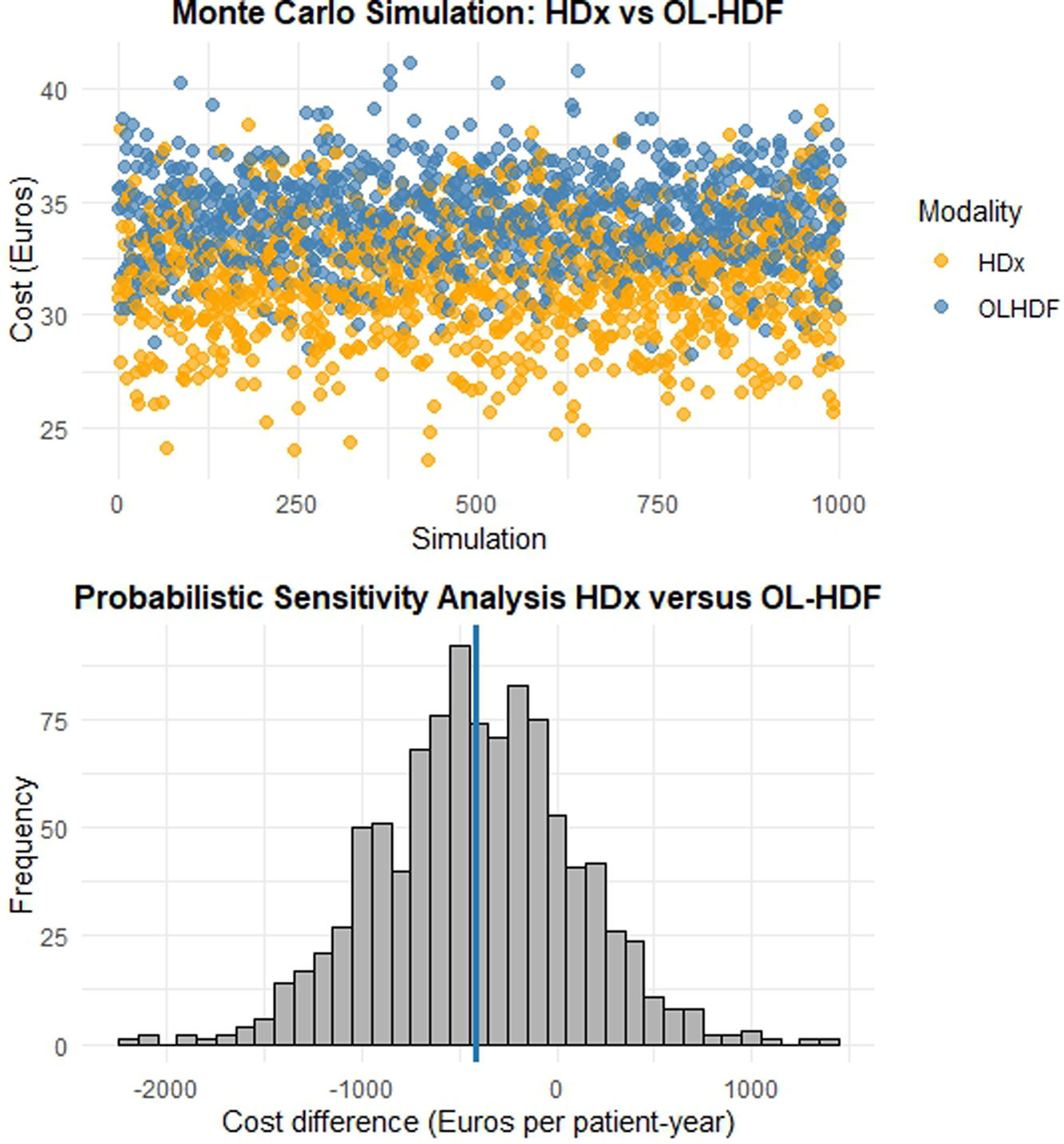
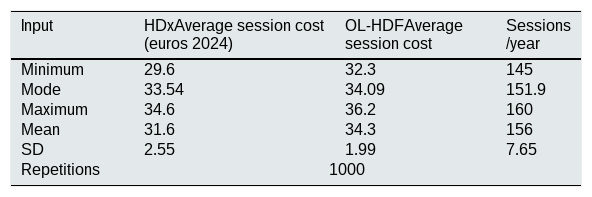
The probabilistic sensitivity analysis (Monte Carlo Simulation) estimated the difference in costs per patient-year between HDx and OL-HDF. Fig. 2 shows that HDx was the dominant strategy in 90% of the simulations. Table 4 presents the variables included in the 1000-repetition simulation. The mean annual savings were €428 per patient, with an interquartile range of €118–766, and a median of €442.
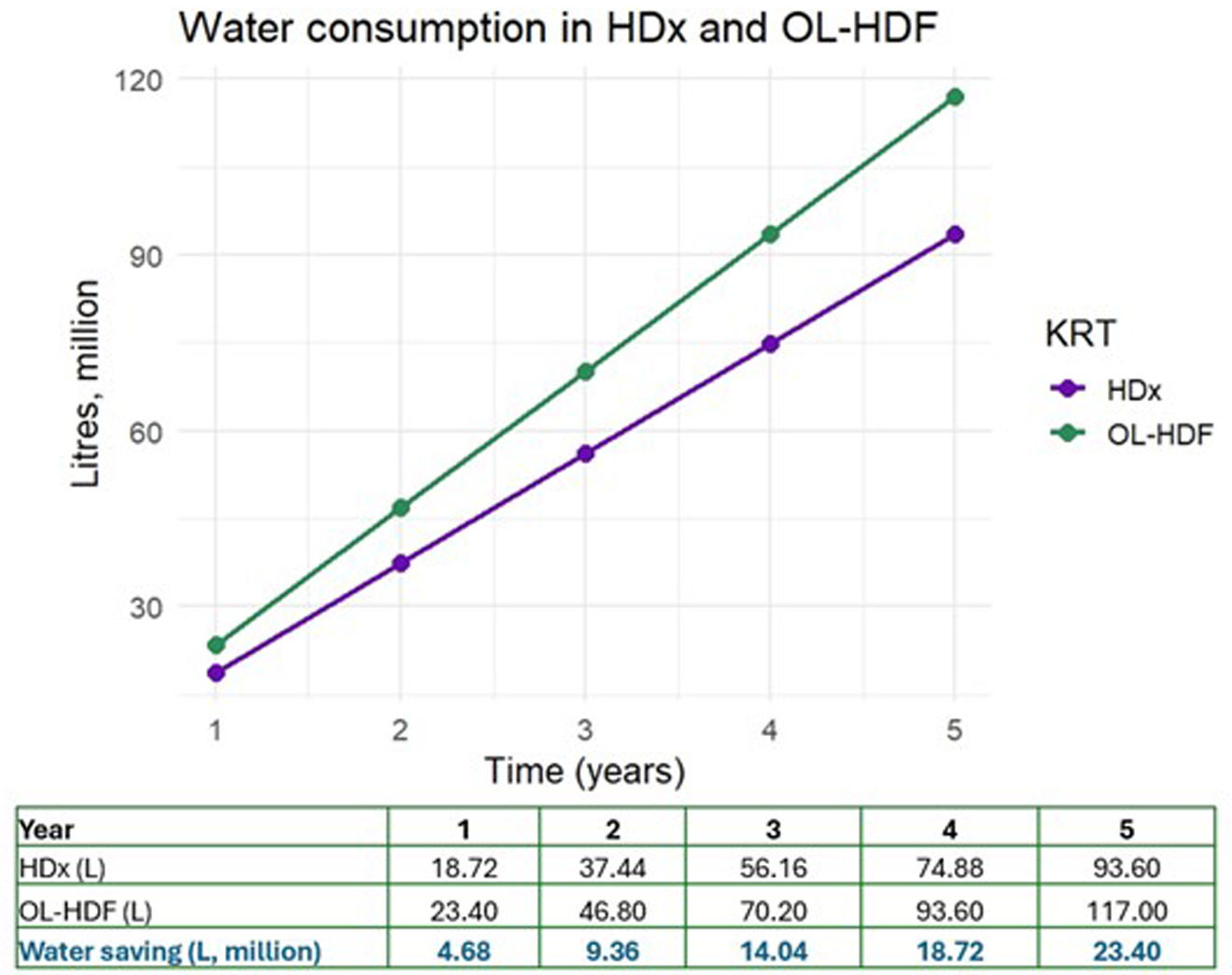
HDx, assuming a duration of 240min per session and a QD of 500mL/min, the total water consumption was 120 liters per session. OL-HDF assuming total flow (total QD) of 625mL/min, consistent with flow of (QD) of 520mL/min and 105mL/min (=25.2L/240min), the total water consumption would be 150 liters per session. The Monte Carlo simulation estimated that over a five-year period a cohort of 1000 patients undergoing 156 HDx sessions annually would use 23.4 million liters of water less than the amount that would be needed for OL-HDF. Additional information is provided in Fig. 3.
Cumulative water consumption in HDx and OL-HDF over five years. The graph compares the projected water consumption (in millions of liters) associated with HDx and OL-HDF. At each yearly interval, HDx required less water, resulting in progressive savings that reached 23.4 million liters after 5 years.
This study provides new evidence regarding the resource consumption of expanded hemodialysis (HDx) as compared with online hemodiafiltration (OL-HDF) from a provider perspective in Spain operating under a tender contract. Using a detailed micro-costing approach, we found that HDx consistently had less resource consumption than OL-HDF, resulting in savings of €2.7–6.6 per session, depending on the scenario considered. When extrapolated to an annual horizon, HDx generated a mean saving of €428 per patient, and probabilistic analyses confirmed HDx as the dominant strategy in 90% of simulations.
HDx has been shown to have comparable clinical performance to OL-HDF. Both methods have similar clearance of middle molecules, such as β2-microglobulin, FGF-23, and kappa and lambda free light chains, and both methods preserve plasma albumin concentration.4,16–18 Some observational studies even suggest that HDx may offer a survival benefit compared with high-flux hemodialysis.7 Along with our economic findings, these data suggest that HDx is a clinically effective and resource-efficient option that can be implemented without requiring additional infrastructure. Furthermore, HDx's potential to increase savings is notable, as it does not require substitution fluid or the additional equipment associated with OL-HDF.19
A key contribution of this study is its quantification of the differences in water consumption between the two modalities. HDx requires, on average, 30 liters less water per session than OL-HDF. For a cohort of 1000 patients, this translates to 23.4 million liters of water saved over five years. Considering that, on average, 144 litres of water per person per day is supplied to households in Europe, this saving among 1000 dialysis patients is equivalent to the daily water consumption of 89 households per day.20 Given the increasing global dialysis population and the growing scarcity of water resources, these reductions could significantly contribute to the sustainability of dialysis and the protection of the planet.21–23
A recent literature review indicates that OL-HDF has a carbon footprint that is 30–40% larger than standard hemodialysis. Conversely, the review suggests that HDx can reduce water and energy consumption by 20–50% without affecting clinical outcomes. The review also urges the field of nephrology to consider environmental sustainability a fundamental dimension of value beyond traditional clinical and economic outcomes.24
Differences in water consumption between dialysis modalities may therefore have relevant implications for the sustainability of dialysis programs. In addition to water and energy consumption, dialysis therapies generate substantial amounts of solid waste, largely derived from single-use consumables such as dialyzers, bloodlines, dialysate containers, and packaging materials. Given that patients typically undergo dialysis three times per week, the cumulative environmental burden associated with disposable materials becomes considerable at the population level. Modalities requiring additional disposables or fluid delivery systems may further increase the volume of waste generated per session. Consequently, strategies aimed at optimizing dialysis resource utilization should also consider environmental aspects, including waste generation and sustainable management of dialysis-related materials. These considerations are increasingly recognized within the framework of “green nephrology,” which promotes environmentally sustainable dialysis practices.24
In Spain, as in many other countries, dialysis providers operate under contracts awarded through a bidding process. Small differences in cost per session can have a significant impact on the budget at the population level.25 Therefore, the demonstrated cost savings and environmental benefits strengthen the case for HDx adoption in settings where OL-HDF is expensive or impractical due to infrastructure limitations.
A limitation of this study is that, although the analysis was based on administrative data, indirect costs such as personnel, dialysis monitors, water treatment plants, and equipment depreciation were excluded because they were assumed to be identical across modalities, which could significantly underestimate differences at the system level. Furthermore, the introduction of OL-HDF may require additional costs related to personnel training, infrastructure adaptation, and system maintenance, which were not included in the analysis.
Further research should evaluate the long-term cost-effectiveness of HDx versus online hemodiafiltration (OL-HDF), incorporating clinical outcomes such as mortality, hospitalization, and quality of life. Additionally, studies in diverse healthcare settings, including those in low- and middle-income countries, are necessary to understand the full economic and environmental benefits of HDx.
ConclusionHDx with Theranova offers lower resource use and lower costs compared to OL-HDF by reducing the need for specific consumables other than the dialyzer and for water consumption. These findings support the potential benefit of HDx as an efficient dialysis modality that responsibly uses the planet's resources.
Prior presentationAn abridged version of this data was presented as a poster at the 2025 ASN Congress of Nephrology.
Authors’ contributionsDr. Rivera, Dr. Sanabria, Dr. Lindholm, Dr. Rutherford: Original conception and design of the research project and data interpretation.
Ms. Vesga: Original conception and design of the research project, data acquisition, and data interpretation.
Mr. Quitian: Original conception and design of the research project, statistical analysis, and data interpretation.
All authors have participated in writing the manuscript or in critical review and have provided final approval for the version to be published. All authors verify that they have met all journal authorship requirements. All authors agree to be responsible for all aspects of the work and ensure the publication's accuracy and integrity. All authors have approved the final version of the manuscript submitted for publication.
FundingVantive provided financial support solely for the data analysis conducted by Hoover Quitian. In their capacity as scientific contributors, Vantive-employed authors participated in the study design and interpretation of the results. Aside from these scientific contributions, the sponsor had no role in data collection, data processing, writing of the manuscript, or in the decision to submit it for publication.
Conflicts of interestDr. Sanabria is an employee of Renal Care Services Latin America, and Ms. Vesga is an employee of Renal Care Services Colombia. Dr Rivera is an employee of Vantive, USA. Dr Rutherford is an employee of Vantive, Switzerland. Dr. Quitian is an employee of the Faculty of Economics at the University of the Andes, Bogota, and has received an honorarium for economic analysis from Baxter Healthcare Corporation. Dr Lindholm is an employee of Karolinska Institutet.
The authors would like to express their gratitude to the participants in the study: Juan Francisco Ruiz (CAN, Murcia), Jesús Abellán Risque (ENGR, Murcia), Jorge Reichert (MD, Murcia), and Julia Martínez (RN, Murcia).